Hanging at The Cliff

We recently got a chance to try our hands at one of the largest sports climbing facilities in Singapore – The CLIFF. Here’s my hubby’s account of our experience of the session. [Apparently now it seems that he’s the one detailing the adrenaline-pumping adventures (see his review of his iFly experience) and unusual experiences like the one where he and my girl slept over at S.E.A. Aquarium.]

~~~~~~~~~~~~~~~~~~~~~

The Vertigo Climbing Wall

The Cliff @ Snow City Singapore has the first-of-its-kind Vertigo climbing wall in Singapore, comprising 10 lanes of various difficulty levels. The wall is suitable for Lead and Speed Climbing and allows up to 20 climbers to participate simultaneously.

Easier Lanes for Beginners

Yes, that’s our little girl on her way up!

Intermediate Lanes

That’s me making my way up!

Harder Lanes
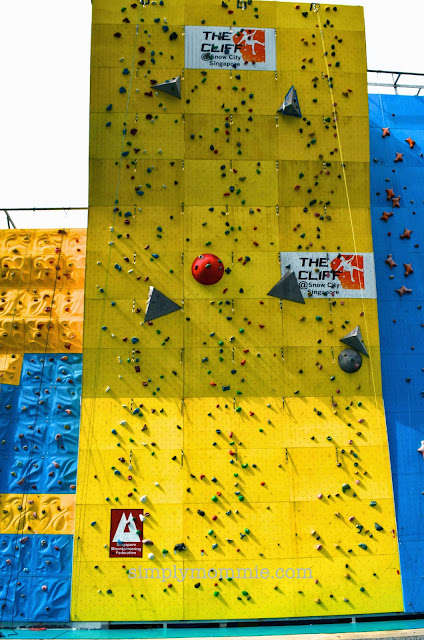
These lanes offer great challenge for the more abled climbers as they can choose to climb using only a single colour of holds.

Speed Climbing Lanes
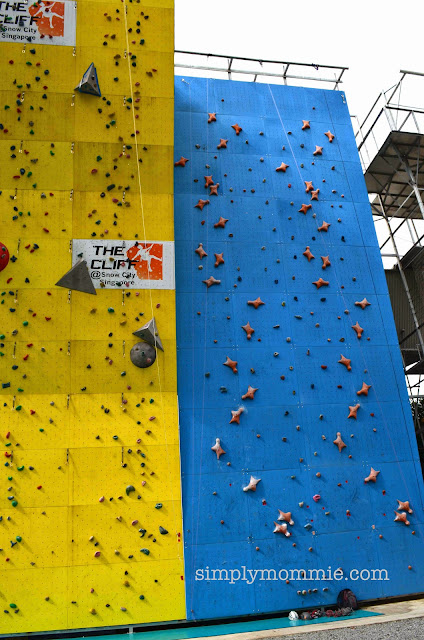
Next to the Harder Lanes, these lanes are mainly used by the more professional climbers training for competitions. The current record to break now is 6 seconds to the top!

Our Climbs

Preparation for the climb was just a breeze as we only had to put on a waist harness with adjustable straps (that was easy enough).
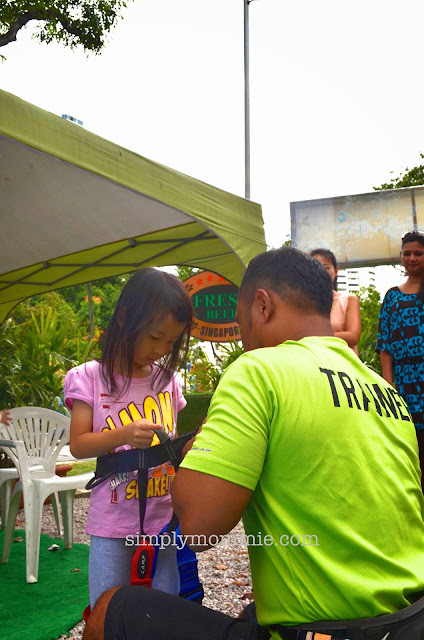
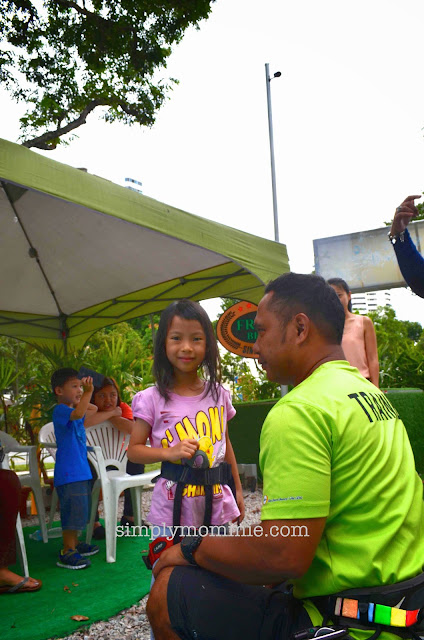
My wife put on a pair of rock-climbing shoes – rental available, but this pair belonged to the trainer and it’s the pair he uses for competitions!

Once done, we just had to take our turns to walk towards the wall and the staff there swiftly but professionally hooked a safety line (or the belaying rope) to our harness using a carabiner. We were also given a short briefing before we got started.
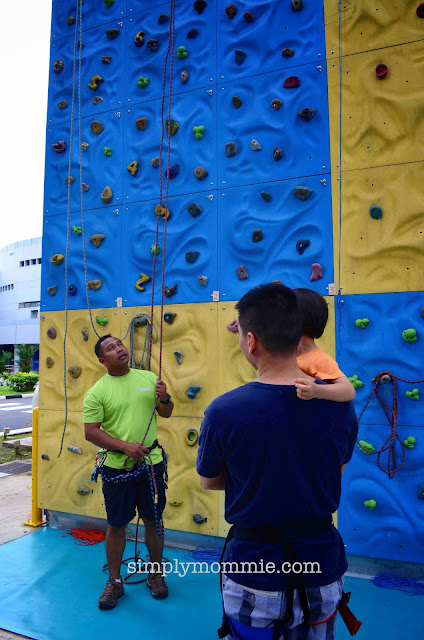
Basically, the trainer told us that:

  • We should keep close to the wall
  • We should try to have 4-point contact with the wall as much as possible
  • we should have at least 2-point contact with the wall and it should be alternate hand and leg in this case (meaning left hand with right leg, or right hand with left leg)

And that’s it! We’re ready to climb!

The 4 of us got to try climbing the easiest wall.
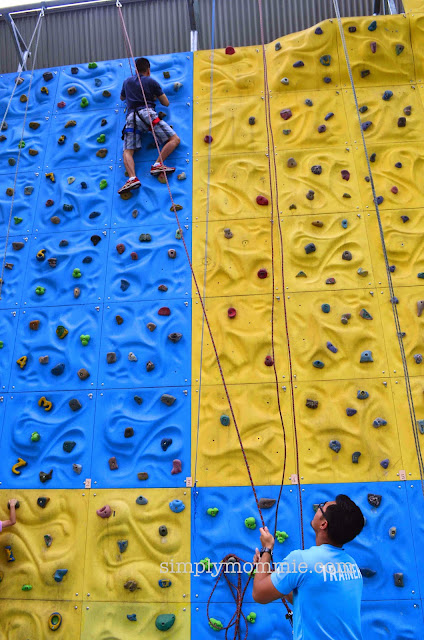
All of us made it up there except our little boy who just turned 3 in October. He only hung on to the lower section and start whining (as he usually does in the face of challenge). Well, since he still did not want to climb after some coaxing, we let him be.
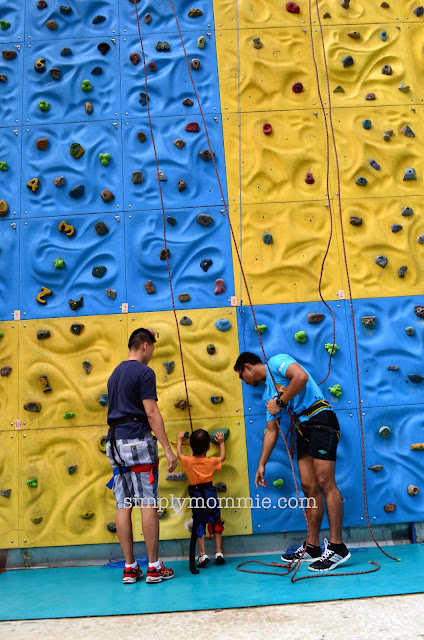
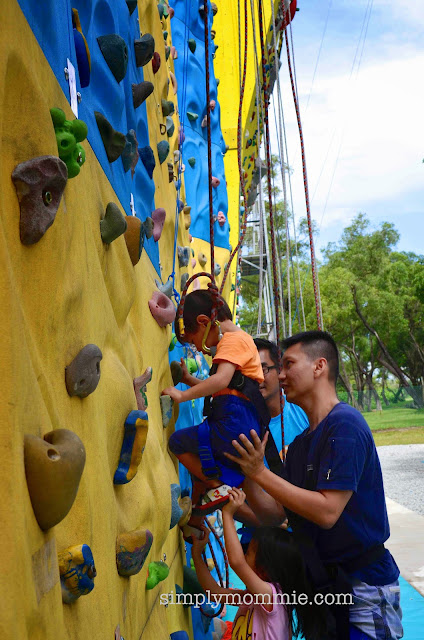
My wife and I climbed up with little difficulty, although it was tiring still. My wife who isn’t used to such sport and hasn’t been exercising was panting badly with soft arms and legs after the climb.
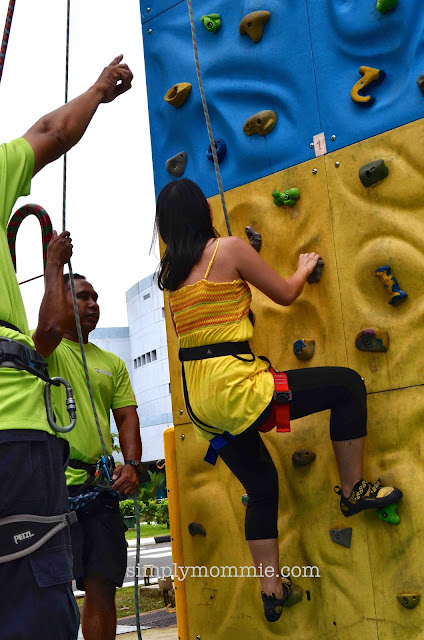
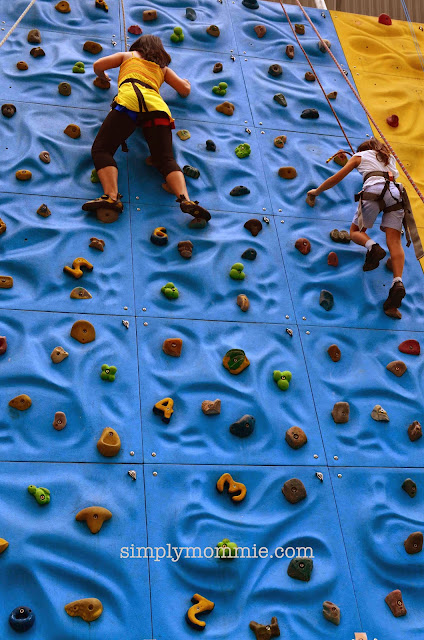
What surprised us was that our girl managed to climb all the way to the top of the easiest lane, all by herself. In fact, she climbed more speedily than my wife!

She made it all the way up!

What’s even more commendable was the fact that our girl had the courage to let go of the wall when told to do so at the top! Well, that was not an easy act, even for adults, as it requires courage and trust that the belayer is able to lower you down safely. To be honest, I felt a little frightened too when I first let go of the wall.

My wife and little girl were too tired after that first climb to try other lanes. But I couldn’t wait to take on more challenge! So I went for the intermediate lane, the one with a slight bulge halfway up there. I would have to say that at my current level of fitness and strength, this IS the most I can do! I had a much longer climb up this lane compared to the earlier lane because there are less holds, smaller holds that are hard to grip, and the bulge makes it hard to stay close to the wall naturally.

Yeah! Up top!

My arms were burning even before reaching the bulge due to the smaller holds that were further apart. And when I reached the bulge, I struggled badly to find holds that are near to me and offer sufficient grip. At several occasions at this region, I wanted to let go because I felt rather helpless and hopeless when I couldn’t seem to successfully find the best holds. I moved sideways to find better holds, left, and right, repeatedly. Soon I was panting just holding on to the tiny holds. Eventually I made the break when I made a further reach upward for a bigger hold with my wobbly arm. Once I could get a good grip, I was soon able to get up to the top of the lane. Phew!

Abseiling

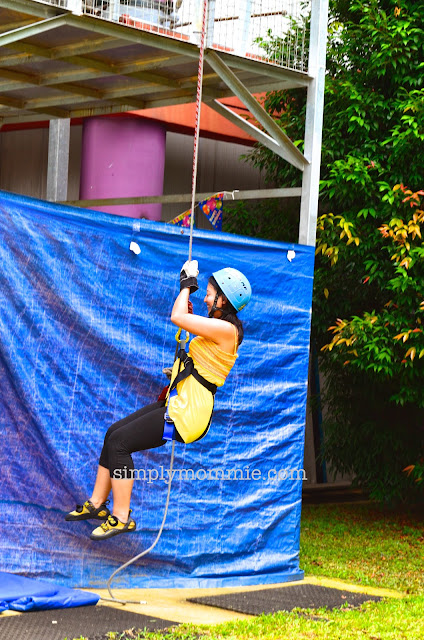
What’s good about this facility is that it also has a separate tower just beside the wall for abseiling. So it offers another different form of activity with similar excitement at the same convenient location.
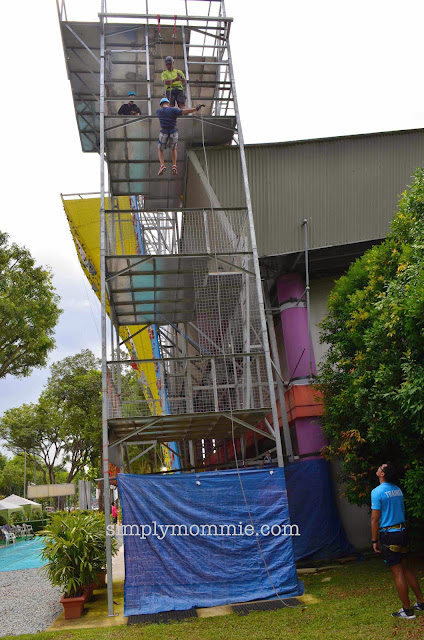
My wife and I tried abseiling but our girl refused. Maybe the sight of climbing up a tower and sliding down a thin rope looked daunting to her. Both my wife and I found the abseiling experience fun but safe, although the climbing up the ladder actually offered more challenge for my wife compared to the actual abseiling.
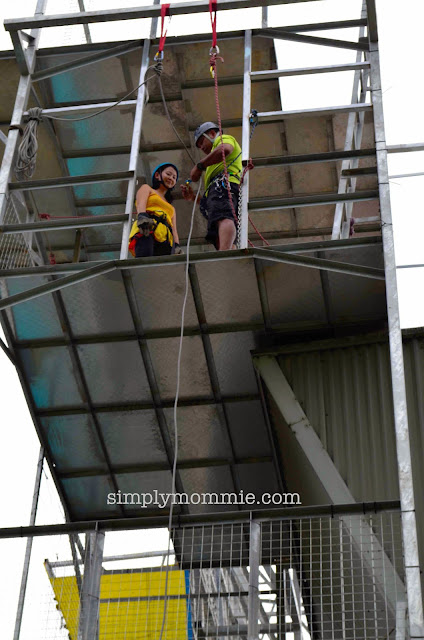
 

Briefing before stepping off
The Good About The CLIFF

From this short little climbing experience, we found the facility:

  • Convenient:   There’s hardly any equipment needed (simple attire with bermudas or tights or pants and covered shoes) and the preparation is a breeze. You can even rent a pair of shoes if you are not wearing shoes.
  • Safe:   The activities here are definitely safe, even for the little ones.
  • Challenging for the body:   Climbing the wall was definitely not easy. Most first timers cannot last more than 3 climbs in the same session. But with more practice, the body will get better in terms of balance, coordination, strength and flexibility.
  • Challenging for the mind:   Because of the physical challenge that climbing offers, the mind is put to the test when the body is tired hanging on in the middle of the vertical wall. This offers a good opportunity for one to improve his/her mental resilience.
  • Forces one to problem-solve:   Maybe we can think of climbing as a problem sum with multiple solutions as there are many ways one can climb to the top. It also encourages one to plan his path ahead.
  • Family-friendly:   The fact that even children can climb makes the activity perfect for families with young children. The wall is generally suitable for ages 6 and above but the stronger lot of the younger toddlers (age 3 and above) can also give it a try. Encouraging one another also provides a great opportunity for bonding.

So if you are looking for a safe, healthy and challenging activity for the family, give this a serious thought!

Check out The Cliff @ Snow City Singapore for more information.

Disclosure: We were invited to hang out at The Cliff. No monetary compensation was provided.

~~~~~~~~~~~~

Lovely and constructive comments are welcomed. Do hop over to my Facebook page where I connect with my readers and I would love to have you following me on Pinterest, Twitter and Instagram too 🙂

Posted in Places & Events, Reviews | Leave a comment

5 points to consider when choosing pre-school enrichment classes

The school year has come to a close and some of you might be considering enrolling your kids in some enrichment classes for the coming year. I thought I’d share with you 5 key points I look out for when I choose pre-school enrichment classes and also an enrichment centre that I’ve recently discovered which offers quality classes for pre-schoolers. I mean, they’ve been like around for a long, long while now and we associate it with learning British English (get the hint?) and there’s even free trial classes coming up soon – but more on that later.

Choosing pre-school enrichment classes – what to look out for

1. Professional, trained staff who can connect with kids

I think we all agree that when we choose to send our kids for enrichment classes, we’d expect that the teachers are professional and trained. I mean, if not, we could jolly well do it ourselves. But what usually makes me pay more attention to an enrichment centre is how well the teachers connect with the children. And those are the ones who will usually stand the test of time.

2. Good teacher-student ratio

Since we’re paying for these extra classes, I would expect a good teacher-student ratio so that my kid can get the attention to progress faster, in whatever field it is. I think this is especially crucial for pre-schoolers because they definitely need a lot more guidance and teaching compared to older children. I’d say probably not more than 10 students to 1 teacher would be good.

3. Well structured/ thought-out curriculum

When I visit any enrichment centre that I’m interested in, I’d always ask to look at their curriculum. Some things don’t ever get out of my system even though I’ve left the education service I guess. But I think it’s a reasonable request to ask for the curriculum to see if it suits what you’re looking for, and whether it actually covers what you want for your child.

4. Adopts a multi-sensory approach

Even for older children, I think it’s useful to adopt a multi-sensory approach. I mean even at tertiary level, I was far more engaged in a lesson if the teacher incorporated various approaches instead of expecting me to stay in my seat for the duration of the class. I’m not a particularly kinaesthetic learner but I do appreciate having the opportunity to not be stuck in a chair or on the floor for prolonged periods of time. And for a pre-schooler, prolonged periods of time could mean 15 minutes, so it’s a must to find out more about the structure of the lesson when you’re checking out an enrichment centre.

5. Builds confidence

While most of us actually send our kids for enrichment to learn something new or to enhance learning of a particular subject, I think it’s important that the enrichment class helps to build the child’s confidence over time. After all, enrichment class serves to ‘enrich’ the child’s life and I see character development as key to success in other pursuits in future.

~~~~~~~~~

I visited British Council’s Marsiling Centre recently to find out more about the enrichment programmes, in particular the pre-school enrichment programmes and had a chat with Sarah Mills, Head of Preschool, so I could share more about their programme with you.

I’ve always thought that British Council only offers classes for older students but apparently in recent years due to popular demand, they have opened up enrichment classes for the pre-school level as well.

If you’re wondering how the enrichment classes at British Council compare to others, you’d be glad to know that you can do the comparison yourself by having your children attend FREE trial classes during their Open House which is coming up soon (details at the end of the post) at all four centres.

You may remember that I’ve reviewed their daily 3-hour Preschool programme that was launched this year at only the Tampines centre. These once-a-week enrichment lessons, however, are available at ALL four centres throughout the island and cater to a range of students from the ages of 4 to the age of 18. These weekly enrichment courses address the various concerns of students at different ages. For example, the enrichment courses for pre-school children will focus on Phonics, Literacy, Creative Writing, confidence building, to help them get ready for Primary school. The enrichment courses for Primary, Secondary and JC students focus on teaching the skills and knowledge to help them achieve exam success and prepare for the key examinations such as the PSLE, O-Levels and A-Levels.

The pre-school enrichment lessons are recommended for students who need additional support and practice with phonics and language development, but of course this is not limited to those who need that extra guidance. I find that having native speakers teach the children at the centres is very beneficial for building the foundation in the language, especially when they are just starting to learn to read.

The British Council Singapore is also committed to inclusion therefore they have a range of academic abilities with the classroom, and you do not need to worry whether there is any sort of ‘ranking’ within the class.

Any prerequisites for attending their pre-school enrichment classes? N2 and K1 are infilled by age, i.e. 3-4 year olds are Nursery 2, 4-5 year olds are K1. For new K2 students (who are not from their existing K1 classes), there is a placement test. This is to ensure the student has the required level of phonics to start the K2 programme rather than to place any judgement on the child. For non-Singaporean students, a simple placement test is done to ensure their language ability is adequate for the Pre-school course.

Since my girl is 6 this year and many parents of 5-6-year-olds are similarly worried about being adequately prepped for P1, I thought I’d find out more about the K2 course. The K2 course at British Council covers a range of skills such as comprehension skills and simple creative writing based on course themes (e.g. Families and Friendship, Sea Creatures) on top of their phonics programme.

The beautifully decorated board for the current theme of Sea Creatures

There is also a weekly spelling test and practice of simple vocabulary clozes. The K2 course also encourages learner autonomy and fosters classroom routines in preparation for P1.

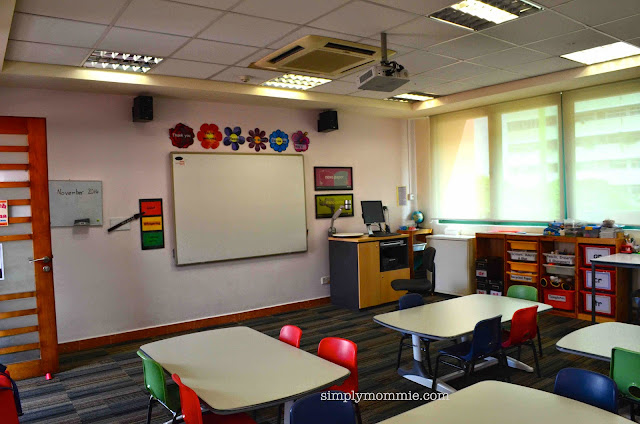
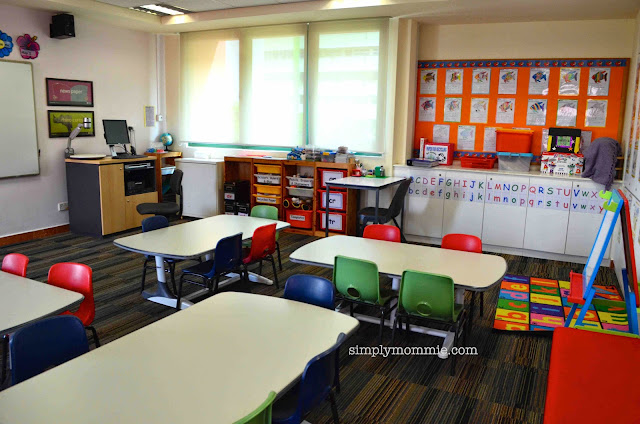
The Pre-school courses at British Council focus on whole child development in a friendly and safe environment. The classrooms are child-friendly and decorated with the children in mind, well-equipped with interactive white boards,

Even the notice board outside the classroom is well-utilised to reinforce what’s learnt in class

and the classes are fun, communicative and interactive.

Trial class of a previous Open house

Children are captivated and are not afraid to participate in the safe classroom environment

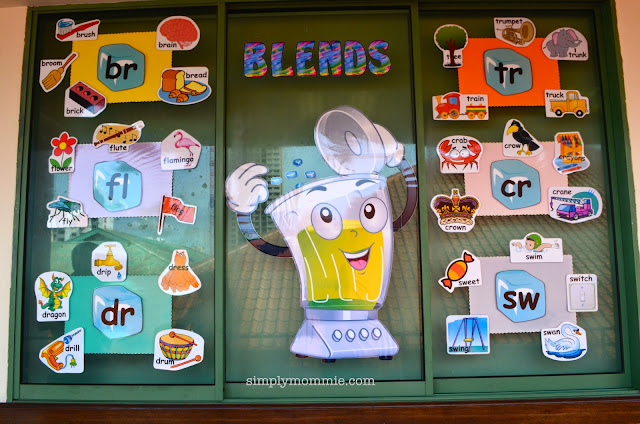
They also believe in the use of a multi-sensory approach to teaching the children as they acknowledge that everyone has different learning styles – this is why they have chosen to use Jolly Phonics system in their curriculum.

The N2 class takes in a maximum of 12 students, while the K1 and K2 classes have a maximum of 16. All classes have a teacher and a teacher assistant so effectively, the teacher-student ratio is 1:6 and 1:8 for N2 and K1/K2 respectively.

The class is 1h 45min, and typically begins with Settling Time where children are allowed to play independently for up to 20 min (the time taken to settle down is longest for the youngest age group, N2). Circle Time is next where children get to share news, do a show and tell, read aloud session and this is where they will get to build up their confidence in speaking to a group, learn turn-taking and listening to others. For the K2s, there will be a spelling test after that. All pre-school classes will then cover the Phonics component followed by an interactive Storytelling session.

As you can see, there is a focus on social development and confidence building apart from academic achievement. But I’d suggest that you don’t take my word for it since preferences for enrichment classes are highly subjective. The best thing you should do is to go ahead to take full advantage of the Free Trial Lessons and Free Parent Workshops that will be available during the Open House at ALL four centres –

Free Trial Lessons  Free Parent Workshops
Stories and Language Games(N2 to K2) Introduction to British Council Methodology
Reading, Vocabulary and Comprehension(P1 to P3) Early Literacy Skills for Pre-school
Get Ahead for PSLE (P4 to P6) Creative writing, with Duncan Watt
Secondary Comprehension Skills PSLE Skills
O-Level Exam Skills Parenting Skills, with Noreen Boyle
Open House Location Date Tel
Tampines Centre 29 Nov (Sat) +65 6653 8040
Toa Payoh Centre 30 Nov (Sun) +65 6653 8059
Napier Road Centre 06 Dec (Sat) +65 6653 8046
Marsiling Centre 07 Dec (Sun) +65 6653 8049

Open House is from 10am to 4pm.

Trial lessons by British Council Pre-school (daily 3-hour programme) are also available only at the Tampines Centre.

More information about the Open House can be found here or call ANY of the four centres to find out more. A more detailed description of the Pre-school enrichment classes can be found on the British Council website.

Disclosure: This is an advertorial. All opinions are mine.

Posted in Advertorials | Leave a comment